
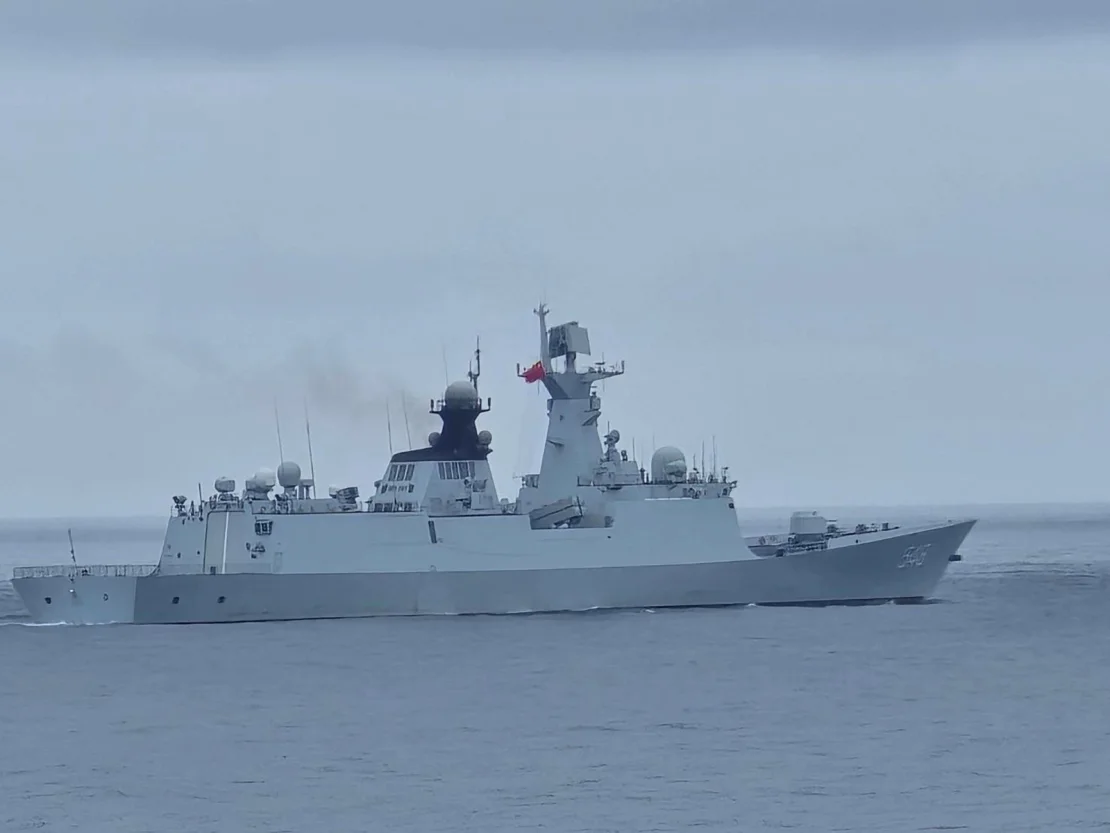
A well-known think tank has warned that without firing a shot, China’s military might isolate Taiwan, destroy its economy, and force the democratic island to submit to the wishes of Beijing’s governing Communist Party.
Concerns about the possibility that the Communist Party may fulfil its vow to seize Taiwan in the future—by force if necessary—have intensified in the wake of Chinese President Xi Jinping’s more aggressive behaviour towards the independent island.China’s silence on Russia’s invasion of Ukraine has only heightened such anxieties.In such a scenario, analysts and military strategists have long focused on two key options available to China – a full-scale invasion or a military blockade.
But a Washington think tank, the Center for Strategic and International Studies (CSIS), warns there is a third way, one that will make it far harder for the United States and other like-minded democracies to counter: Quarantine.Using “gray zone” tactics – actions just below what might be considered acts of war – the China Coast Guard, its so-called maritime militia and various police and maritime safety agencies could initiate a full or partial quarantine of Taiwan, possibly cutting off access to its ports and stopping vital supplies like energy from reaching the island’s 23 million people, a newly released report from CSIS says.
At the Shangri-La Dialogue defense summit in Singapore earlier this month, Chinese Defense Minister Adm. Dong Jun warned those who support any moves for Taiwan independence will “end up in self-destruction.”
“We will take resolute actions to curb Taiwan independence and make sure such a plot never succeeds,” said Dong, speaking through a translator, while slamming “external interfering forces” for selling arms and having “illegal official contacts” with Taiwan.China’s escalating gray zone tactics were on stark display this week as China Coast Guard vessels clashed with Philippine Navy boats in the South China Sea.
Videos showed Beijing’s troops threatening Filipinos with an axe and other bladed weapons, and Manila said one of its soldiers lost a thumb in a Chinese-instigated collision.
The level of violence was a major step up from previous clashes near Second Thomas Shoal, where the Philippines maintains an outpost on a beached warship in waters claimed by both Beijing and Manila.Similarly, Beijing’s military and economic intimidation of Taiwan, a highly developed free-market economy, has grown much more pronounced under Xi.
China’s ruling Communist Party claims the island as its own, despite never having controlled it, and has vowed to “reunify” with it, by force if necessary.But the CSIS report says Beijing has strong options that could not only keep the PLA out of the fight but could actually put the island democracy or its supporters like the United States in the role of initiators of military conflict to preserve Taiwan’s autonomy.“Demonstrated Chinese willingness to search and seize only a handful of commercial ships could have an outsized deterrent impact and discourage similar transgressions,” the report states.
Limited search and/or seizure actions have an effect on flights to Taiwan as a quarantine can easily be extended to the air, the report states.Only a handful of flights would need to be warned off by Chinese aircraft to have a stifling effect on all traffic, according to the report.China regularly flies military aircraft around the island, sometimes dozens in a day. In the 24 hours ending at 6 a.m. Friday, 36 Chinese military aircraft crossed into Taiwan’s air defense identification zone, Taiwan’s Defense Ministry says.
Meanwhile, a quarantine, rather than a blockade, would not require China to close or restrict access to the Taiwan Strait, the CSIS report notes. That means Washington and its allies could lose one of their biggest claims to intervene under international law, preserving freedom of navigation in an international waterway.“If the quarantine is cast as a law enforcement operation, China can easily announce the end of the operation and claim its objectives were met,” the report says.Taiwan is a prominent industrialized economy, a crucial node in global supply chains and a manufacturer of the vast majority of the world’s most advanced semiconductors. A quarantine on the island would have economic repercussions not just domestically, but globally.
While most nations diplomatically recognize Beijing over Taiwan, the island has forged increasingly strong unofficial relations with major western democracies, deepening those ties in recent years as Beijing’s threats have hardened.Taiwan and China are also deeply economically intertwined. Last year, 35% of the island’s exports went to the Chinese mainland, most of which were integrated circuits, solar cells and electronic components, according to Taiwan’s Ministry of Economic Affairs.
Imports from the mainland accounted for 20% of the island’s total imports in the same year. Between 1991 and 2022, Taiwanese companies invested a total of $203 billion in the mainland, according to Taiwan government statistics, creating millions of jobs in China.Additionally, quarantines can push populations to rally with the government, rather than rise up against it, says Sidharth Kaushal, senior research fellow at the Royal United Services Institute in London.
“Historical evidence shows that even severe blockades have limited coercive value, and a limited quarantine might result in a rally around the flag effect,” he says.A quarantine could also push Taiwan’s government to declare independence, something Beijing has repeatedly said would likely bring armed conflict, Kaushal warns.“This would then leave the (Communist Party) with the options of either escalation or a major setback,” he says.Patalano says for China, patience is the key to realizing its goal of “reunification.”Escalation, and certainly invasion, is not “cost-efficient,” he says. War costs not only lives but national wealth.
Source: Here
