
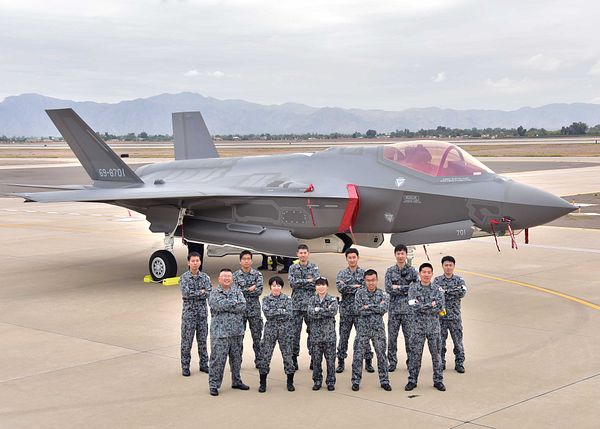
As part of a $10 billion modernization of its forces in Japan, the US military will deploy several of its newest fighter jets, the Defence Department said on Wednesday.
The Pentagon said in a news statement that the initiative would be implemented “over the next several years” with the goals of “bolstering regional deterrence, strengthening peace and stability in the Indo-Pacific region, and enhancing the US-Japan Alliance.”
The modernization plan will see 48 fifth-generation F-35A fighters replace 36 F-16s at Misawa Air Base in northern Japan, and 36 brand-new F-15EX jets deploy to Kadena Air Base on the southern island of Okinawa, replacing 48 older F-15C/D models that have been pulled from the region in the past year, the Pentagon release said.
At Marine Corps Air Station Iwakuni, just south of Hiroshima on the main island of Honshu, the number of deployed F-35B aircraft will be modified, the Pentagon said, without giving specific numbers.“The Department’s plan to station the Joint Force’s most advanced tactical aircraft in Japan demonstrates the ironclad U.S. commitment to the defense of Japan and both countries’ shared vision of a free and open Indo-Pacific region,” the news release said. Japan’s alliance with the US has become increasingly important in a region that is seeing China, Russia and North Korea all pose threats that Tokyo seeks to counter.
Japan has festering territorial disputes in the north with Russia and with China over islands in the East China Sea. Meanwhile, North Korea’s growing missile program, which has seen Pyongyang send missiles over Japanese territory in recent years, draws condemnation from Tokyo with every projectile test.Japan also keeps a wary eye on the situation surrounding Taiwan, the self-ruled democratic island that the Chinese Communist Party has vowed to bring under Beijing’s control, by force if necessary. As much as 90% of Japan’s energy supplies come via sea lanes near Taiwan, according to Tokyo, which sees the status quo around the island as key to its security.
Okinawa is only about 450 miles (725 kilometers) from Taiwan, and both the US and Japan maintain key air bases on the island.he US Air Force calls the Kadena Air Base, home of the 18th Wing, its “Keystone of the Pacific,” and for more than four decades, the older model F-15s based there were central to US deterrence in the region. But from 2022, as the twin-engine fighters neared the end of their service life, the US Air Force began pulling them from Kadena. While the service has rotated other assets through air base since to cover the absence of the older F-15s, the permanent presence of the F-15EXs will bring stability to the force structure.
The F-15EX is a leap above the older models. Manufacturer Boeing says the jet has “unparalleled weapons capacity,” with an ability to carry 12 advanced medium-range, air-to-air missiles (AMRAAM) and to fire them from a range “farther than any other fighter in the US Air Force arsenal.” Although not a stealth fighter like the F-35, Boeing says the F-15EX has next-generation survivability.“The F-35 is an excellent low-observable sensor platform that could operate forward in stealth mode relaying data back to patrolling F-15EXs with their supersonic cruise and large air-to-air missile load outs,” said Layton, a fellow at the Griffth Asia Institute in Australia and former Royal Australian Air Force officer.
The aircraft deployments add to other improvements Washington has been making to its force structure in Japan, where the US has more than more than 50,000 troops. Okinawa houses more than 25,000 US military personnel and more than two dozen military installations. Roughly 70% of the US military bases in Japan are on Okinawa. The US and Japan announced last year that a newly redesignated Marine unit with advanced intelligence, surveillance capabilities and the ability to fire anti-ship missiles would be based in Japan.
Source: Here
Image source: Here
