
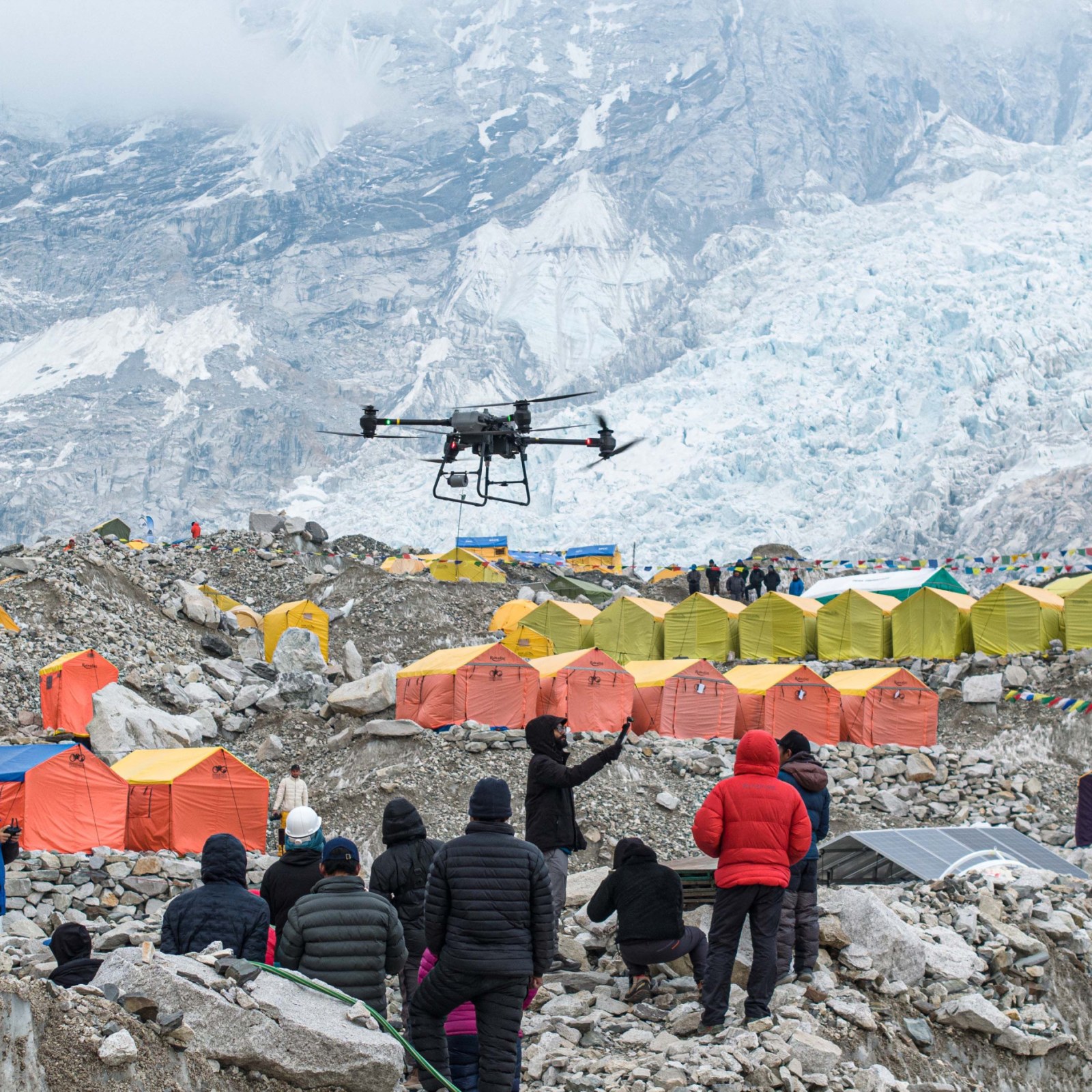
Heavy lifter drones will be used by Nepal to move trash from Ama Dablam, which is 6,812-meters high and located south of Everest. This will be the first time an unmanned aerial vehicle is used for commercial purposes in Nepal’s high-altitude region.
The heavy lifter from Da Jiang Innovations (DJI), the largest drone manufacturer in China, will perform duties that have historically been performed by Sherpas. Authorities think it will contribute to fewer deaths on Mount Everest. Then, DJI drones—which have a sound like a swarm of bees—will be used on Everest throughout the spring, which runs from March to May. It will fly to Camp I (5,943 metres) to supply ropes and ladders to prepare routes and bring garbage to the Everest base camp at 5,364 metres.
On Sunday, a tripartite memorandum of understanding (MoU) was signed between the Sagarmatha Pollution Control Committee, the Khumbu Pasang Lhamu Rural Municipality, and the Airlift Technology Pvt Ltd for the use of advanced drone technology to efficiently manage garbage in the mountains of the Khumbu region. In April, Chinese drone maker DJI conducted the world’s first drone delivery test on Everest. “After a successful test in April, we plan to use drones commercially in the Everest region,” said Jagat Bhusal, chief administration officer of the rural municipality that hosts Everest.
The test result showed that the DJI FlyCart 30, the long-distance heavy lifter drone, could airlift 234 kg per hour between Camp I and Base Camp, a task usually accomplished by at least 14 porters in six hours. Drone manufacturer DJI is under the microscope as US lawmakers push for a ban on Chinese drones, amid deteriorating relations between the US and China, the world’s largest trading nations. Nepali officials and mountaineers, however, see the drone as a life-saving vehicle.
Traditionally, local Sherpa guides are responsible for transporting supplies and clearing trash on Everest. They may need to cross the icefall over 30 times a season to transport supplies such as oxygen bottles, gas canisters, tents, food, and ropes. All climbers and guides must navigate the icefall on the route to the world’s tallest peak. The icefall is so notoriously dangerous that even experienced Sherpas hesitate to move when the sun shines. The Khumbu Icefall, a river of ice a kilometre or so long, is usually crossed at night or early morning, with climbers putting headlamps on their helmets.
Normally, the route is crossed early in the morning, when the ice blocks and the hanging glaciers are stable and avalanche risks are low. During the day, as the sun warms the mountain, the hanging glaciers melt, and ice crumbles, increasing the risk of avalanche. “Using drones will help us avoid the dangers in the Khumbu Icefall,” said Bhusal. On April 18, 2014, an avalanche resulting from a falling serac buried 16 Sherpa guides in the Khumbu Icefall, eventually leading to the cancellation of the season’s expeditions.
Last year, three Sherpa guides mobilised to prepare the routes were buried under the ice masses triggered by an avalanche in the Khumbu Icefall. Their bodies are yet to be recovered.
The Himalayan Database and the government records show that nearly 50 individuals died on the icefall between 1953 and 2023. The climb from Everest Base Camp to Camp I takes six hours. Between these two camps lies the Khumbu Icefall, the most treacherous part of the route. The most exciting and easiest part of the route is reaching Camp II (6,400 metres), which takes four hours from Camp I. There is a set of restrictions in the mountains for carrying loads.
According to government rules, workers climbing high altitudes must not carry loads exceeding 20kg between 5,000 and 6,000 metres, 17 kg between 6,001 and 7,000 metres, 14 kg between 7,001 to 8,000 metres, and 12 kg for altitudes above 8,000 metres. “Yes, there are concerns that the machines may actually cut jobs. But our sole purpose is to reduce potential deaths in the Khumbu Icefall, the danger zone,” said Bhusal. “We will train Sherpas, as drone operators cannot handle tasks at the higher camps. In the future, all work will be done by Sherpas.”
In the trial phase, the drone could lift 30 kg from Camp I. However, its performance dropped to 18 kg from Camp II. “Based on the MoU framework, we will soon sign a commercial agreement with the drone supplier,” said Bhusal. “The municipality will monitor all the activities.” The municipality has, so far, spent Rs800,000 on the trial. Climate change is melting snow and ice, exposing even more garbage and bodies that have been covered for decades on Everest. This waste pollutes the natural environment and poses a severe health risk to everyone who lives in the Everest watershed.
Nearly 100 tonnes of garbage were collected during this spring climbing season from Everest and Lhotse, which share the same base camp. According to the Sagarmatha Pollution Control Committee (SPCC), 77.19 tonnes of waste was collected from the Everest base camp alone during the Spring 2024 climbing season. With 8-9 tonnes coming from the higher camps brought down by the expedition agencies, the SPCC collected 85 tonnes of waste this spring.
Source: Here
