
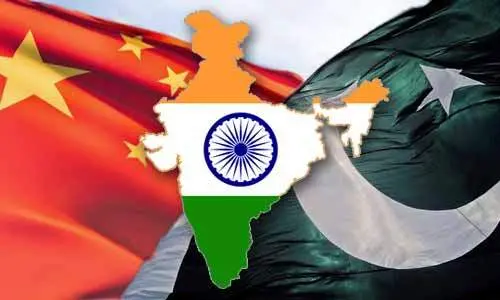
Shares of China’s AVIC Chengdu Aircraft rose 40% this week, as Pakistan claimed it used AVIC-produced J-10C fighter jets to shoot down Indian combat aircraft – including the advanced French-made Rafale – during an aerial battle on Wednesday.
India has not responded to Pakistan’s claims or acknowledged any aircraft losses. When asked about the involvement of Chinese-made jets, a spokesperson for China’s Foreign Ministry said on Thursday he was not familiar with the situation. Still, as Pakistan’s primary arms supplier, China is likely watching intently to find out how its weapon systems have and potentially will perform in real combat.
A rising military superpower, China hasn’t fought a major war in more than four decades. But under leader Xi Jinping, it has raced to modernize its armed forces, pouring resources into developing sophisticated weaponry and cutting-edge technologies. It has also extended that modernization drive to Pakistan, long hailed by Beijing as its “ironclad brother.”
Over the past five years, China has supplied 81% of Pakistan’s imported weapons, according to data from the Stockholm International Peace Research Institute (SIPRI). Those exports include advanced fighter jets, missiles, radars and air-defense systems that experts say would play a pivotal role in any military conflict between Pakistan and India. Some Pakistan-made weapons have also been co-developed with Chinese firms or built with Chinese technology and expertise.
“This makes any engagement between India and Pakistan a de facto test environment for Chinese military exports,” said Sajjan Gohel, international security director at the Asia-Pacific Foundation, a think tank based in London. Chinese and Pakistani militaries have also engaged in increasingly sophisticated joint air, sea and land exercises, including combat simulations and even crew-swapping drills.
“Beijing’s long-standing support for Islamabad – through hardware, training, and now increasingly AI-enabled targeting – has quietly shifted the tactical balance,” said Craig Singleton, a senior fellow at the US-based Foundation for Defense of Democracies.
“This isn’t just a bilateral clash anymore; it’s a glimpse of how Chinese defense exports are reshaping regional deterrence.” That shift – brought into sharp focus by rising tensions between India and Pakistan following a tourist massacre in Kashmir – underscores a broader geopolitical realignment in the region, where China has emerged as a major challenge to American influence. Meanwhile, Pakistan has deepened ties with China, becoming its “all-weather strategic partner” and a key participant in Xi’s signature global infrastructure project, the Belt and Road Initiative. According to SIPRI’s data, the US and China each supplied about one-third of Pakistan’s imported weapons in the late 2000s. But Pakistan has stopped buying American arms in recent years and increasingly filled its arsenal with Chinese weapons.
Siemon Wezeman, a senior researcher in the SIPRI Arms Transfers Program, noted that while China has been an important arms supplier to Pakistan since the mid-1960s, its current dominance largely comes from stepping into a vacuum left by the US. More than a decade ago, the US accused Pakistan of not doing enough to fight “terrorists” – including Taliban fighters – that it said were operating from or being supplied in Pakistan. Wezeman said that added to Washington’s existing frustrations over Islamabad’s nuclear program and lack of democracy. Despite the absence of official confirmation and hard proof, Chinese nationalists and military enthusiasts have taken to social media to celebrate what they see as a triumph for Chinese-made weapon systems.
Shares of China’s state-owned AVIC Chengdu Aircraft, the maker of Pakistan’s J-10C fighter jets, closed 17% higher on the Shenzhen exchange on Wednesday, even before Pakistan’s foreign minister claimed the jets had been used to shoot down India’s planes. Shares in the company rose an additional 20% on Thursday.
The J-10C is the latest version of China’s single-engine, multirole J-10 fighter, which entered service with the Chinese air force in the early 2000s. Featuring better weapon systems and avionics, the J-10C is classified as a 4.5-generation fighter – in the same tier as the Rafale but a rung below 5th-generation stealth jets, like China’s J-20 or the US F-35.
China delivered the first batch of the J-10CE – the export version – to Pakistan in 2022, state broadcaster CCTV reported at the time. It’s now the most advanced fighter jet in Pakistan’s arsenal, alongside the JF-17 Block III, a 4.5-generation lightweight fighter co-developed by Pakistan and China. The Pakistan Air Force (PAF) also operates a larger fleet of American-built F-16s, one of which was used to shoot down a Soviet-designed Indian fighter jet during a flare-up in 2019.
Source: Here
