
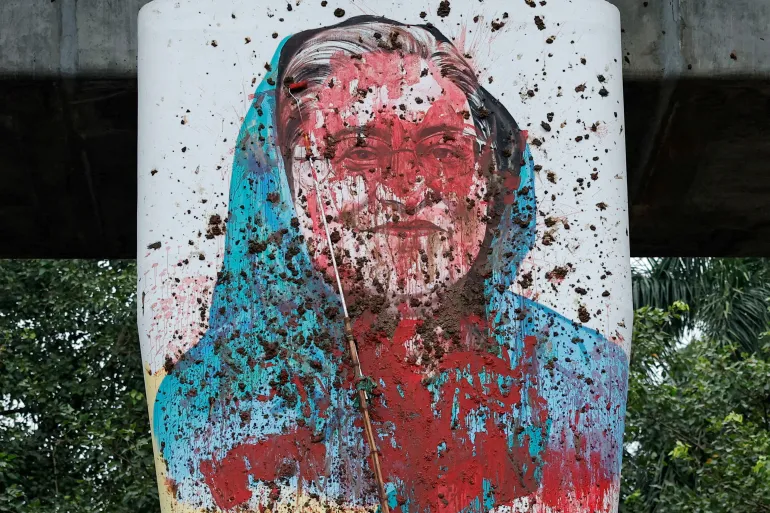
Hasina, Bangladesh’s longest serving prime minister, is the eldest daughter of Sheikh Mujibur Rahman, who led the war for independence from Pakistan in 1971.
The fascist Hasina thought she could not be defeated, that she could rule forever,” Akhter said from Dhaka. “A death sentence for her is a step towards justice for our martyrs.”But, Akhter added, the sentencing itself wasn’t enough. “We want to see her hanged here in Dhaka!” she said.That won’t happen easily. Hasina, who fled Dhaka as protesters stormed her home in August 2024, remains far from the gallows for now, living in exile in New Delhi.
Hasina’s presence in India despite repeated requests from Bangladesh to hand her over has been a key source of friction between the South Asian neighbours over the past 15 months. Now, with Hasina formally convicted of crimes against humanity and sentenced to death, those tensions are expected to rise to new heights. Even though India is eager to build a partnership with a post-Hasina Dhaka, several geopolitical analysts said they cannot envision a scenario in which New Delhi turns the former prime minister over to Bangladesh to face the death penalty. She first became prime minister in 1996. Defeated in the 2001 election, she was out of power until she won again in 2009. She remained in office for 15 years after that, winning elections that opposition parties often boycotted or were banned from contesting in amid a broader hardline turn. Thousands of people were forcibly disappeared. Many were killed extrajudicially. Torture cases became common, and her opponents were jailed without trials.
Meanwhile, her government touted its economic record to justify her rule. Bangladesh, which former US Secretary of State Henry Kissinger had once called a “basket case” economy, has in recent years witnessed rapid gross domestic product growth and has outpaced India’s per capita income.
But in July 2024, a student protest that initially began over government job quotas for descendants of those who fought in the 1971 war of independence from Pakistan escalated into a nationwide call for Hasina to go after a brutal crackdown by security forces.
Student protesters clashed with armed police in Dhaka, and nearly 1,400 people were killed, according to estimates by the United Nations.
Hasina, a longtime ally of India, fled to New Delhi on August 5, 2024, and Nobel Peace Prize laureate Muhammad Yunus took over as interim leader. Yunus’s government has since moved to build closer ties with Pakistan amid tensions with India, including over Dhaka’s insistence that New Delhi expel Hasina.
On Tuesday, Dhaka’s Ministry of Foreign Affairs raised the pitch against New Delhi further. The ministry cited an extradition agreement with India and said it was an “obligatory responsibility” for New Delhi to ensure Hasina’s return to Bangladesh. It added that it “would be a highly unfriendly act and a disregard for justice” for India to continue to provide Hasina refuge.
Political analysts in India, however, pointed out to Al Jazeera that an exception exists in the extradition treaty in cases in which the offence is “of a political character”. “India understands this [Hasina’s case] to be political vindictiveness of the ruling political forces in Bangladesh,” said Sanjay Bhardwaj, a professor of South Asian studies at the Jawaharlal Nehru University in New Delhi.
In New Delhi’s view, Bhardwaj told Al Jazeera, Bangladesh is today ruled by “anti-India forces”. Yunus has frequently criticised India, and leaders of the protest movement that ousted Hasina have often blamed New Delhi for its support of the former prime minister.
Against this backdrop, “handing over Hasina would mean legitimising” those opposed to India, Bhardwaj added. India said in a Ministry of External Affairs statement that it has “noted the verdict” against Hasina and New Delhi “will always engage constructively with all stakeholders”.
India said it “remains committed to the best interests of the people of Bangladesh, including in peace, democracy, inclusion and stability in that country”.
Yet the relationship between New Delhi and Dhaka today is frosty. The flourishing economic, security and political alliance that existed under Hasina has now morphed into ties characterised by mistrust.
Chakravarty, the former Indian high commissioner, said he does not expect that to change soon.
“Under this government [in Dhaka], the relationship will remain strained because they will keep saying that India is not giving us Hasina back,” Chakravarty told Al Jazeera.
But he said Bangladesh’s elections scheduled in February could offer a new opening. Even though Hasina’s Awami League is banned from contesting and most other major political forces – including the biggest opposition force, the Bangladesh Nationalist Party – are critics of New Delhi’s, India will find it easier to work with an elected administration.
“We cannot carry on like this, and India needs an elected government in Dhaka,” Chakravarty said of the tense ties between the neighbours. “India should wait and watch but not disturb the other arrangements, like trade, in goodwill.”
Sreeradha Datta, a professor specialising in South Asian studies at India’s Jindal Global University, said India has been caught in a bind over Hasina but is not blind to the popular resentment against her in Bangladesh.
In an ideal scenario, she said, New Delhi would like to see the Awami League back in power in Bangladesh at some point in the future. “She [Hasina] is always the best bet forward for India,” Datta told Al Jazeera.
But the reality, she said, is that India needs to accept that Bangladesh is unlikely to ever give Hasina another chance. Instead, India needs to build ties with other political forces in Dhaka, Datta said.
“India never had a good equation with any of the other stakeholders there. But that has to change now,” Datta said.
Source: Here
