
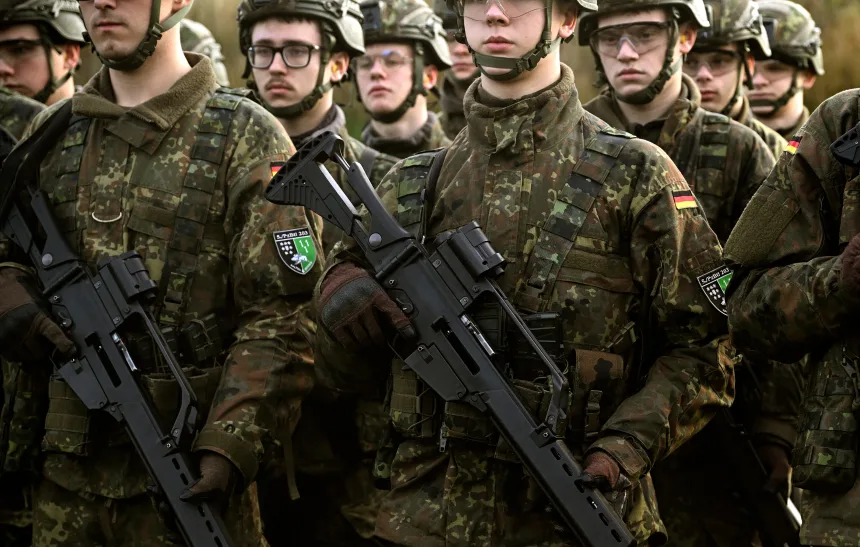
This year, German Chancellor Friedrich Merz pledged to build Europe’s strongest army – a tall order for a country whose military has undergone years of neglect.
The coalition government is hoping a new bill agreed upon last week will help make this a reality, bolstering Germany’s forces in the face of the perceived threat from Russia and a significant shift in US foreign policy.
The sweeping new reforms will see Germany attempt to boost its numbers to 260,000 soldiers, up from around 180,000 currently, in addition to an extra 200,000 reservists, by 2035.
In the first instance, the drive will focus on voluntary enlistment, with greater incentives for those who sign up, including a monthly starting salary of €2,600 ($3,000) – an increase of €450 from the current level.
If the new quotas are not met, the government will have the option of mandatory call-ups, where necessary.
From next year, all 18-year-olds will receive a questionnaire about their interest in serving. For men, answering this will be compulsory. From 2027, men aged 18 will also have to undergo mandatory medical examinations.
It comes as the Trump administration warns that Europe must take responsibility for its own security, Russia’s war in Ukraine continues to grind on and experts on the region suggest Moscow could next invade a NATO state. Germany’s chief of defense, Gen. Carsten Breuer, said in a June interview with the BBC that NATO should prepare for a possible Russian attack within the next four years – possibly as early as 2029 – urging member states to be prepared.
Ahead of the new bill, the coalition partners – the conservative Christian Democratic Union (CDU) and center-left Social Democratic Union (SPD) – had wrangled for weeks over what kind of military service should be introduced. One idea was a “lottery-style conscription,” which would have seen a draw used to select young men for medical screening, and then another to call them up for service. That proposal was ultimately scrapped by Defense Minister Boris Pistorius, who instead said enlistments should center around incentives such as better pay and other financial compensation.
Germany previously had mandatory military service for males aged 18-23, but this was suspended in 2011 in favor of an all-voluntary army.
The deal still needs to be approved in Germany’s Parliament, or Bundestag, with lawmakers expected to vote on it by the end of the year. If that happens, it would come into effect on January 1, 2026.
Pistorius, of the SPD, welcomed the move while seeking to reassure those affected. “There is no reason for concern, no reason for fear,” he said after the agreement was announced last week.
Source: Here
