
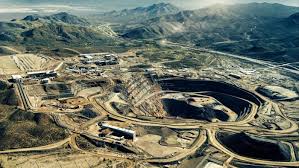
In the sienna-colored curves of Pakistan’s Hindu Kush mountains, one of the most rugged and lawless regions in the world, a cavernous, grooved crater gouged out from a hillside shines in the winter sun, just ten miles from the border with Afghanistan.
Hundreds of millions of dollars’ worth of copper, 22,000 tons, was last year dug out of this crater –– the Muhammad Khel Copper Mine –– and hauled off to China; a nation with a seemingly insatiable appetite for metals and minerals.
In a neighboring province lies another copper mine that Pakistan says can yield almost ten times as much, equivalent to a fifth of the copper America uses every year. The prospect is so appealing to a Washington administration also hungry for resources that it has put up more than a billion dollars to get things moving.
Pakistan says there is much more wealth beneath its soil –– an estimated $8 trillion in copper, lithium, cobalt, gold, antimony and other critical minerals. And that claim has oiled an unlikely friendship with US President Donald Trump, who has put mineral acquisition at the heart of US foreign policy.
But the treasure Pakistan claims to be sitting on is located in border areas wracked by decades-long jihadist insurgencies, that have grown more widespread and deadly since the chaotic US withdrawal from Afghanistan in 2021 left behind a cornucopia of hastily abandoned weaponry.
On an exclusive trip to some of Pakistan’s most dangerous areas, a CNN team was shown hundreds of US-made rifles, machine guns and sniper rifles –– all leftovers from Washington’s war next door, and all seized from a new breed of jihadists and insurgents.
Around 50 miles from the Muhammad Khel Copper Mine near the western town of Wana, outside a military cadet college building recently hit by a Pakistani Taliban suicide attack, a colonel laid out a blood-soaked bandana and three M-16 rifles recovered from the militants. Written on the bandana, in Urdu and English, were slogans indicating the wearer’s readiness for martyrdom. And stamped on the rifles were the words: “Property of US Govt. Manufactured in Columbia, South Carolina.”
The high-tech arsenal left behind by America is now turbocharging insurgencies in the border region, and its complicating efforts by the US and Pakistan to exploit its vast mineral riches. Reading the room, Pakistan’s prime minister Shehbaz Sharif and Field Marshal Asim Munir took an unusual prop on their first joint visit to the White House in September –– a chest containing a trove of rare earths they said had been dug from Pakistan’s soil.
Trump was charmed.
The following month he praised Munir in public –– naming him: “My favorite field marshal.”
Pakistan also piqued his interest by touting vast reserves of another metal: copper –– needed for the cables that transmit electricity to homes, the semiconductors behind AI development and other tech across the defense industry.
Source: Here
