
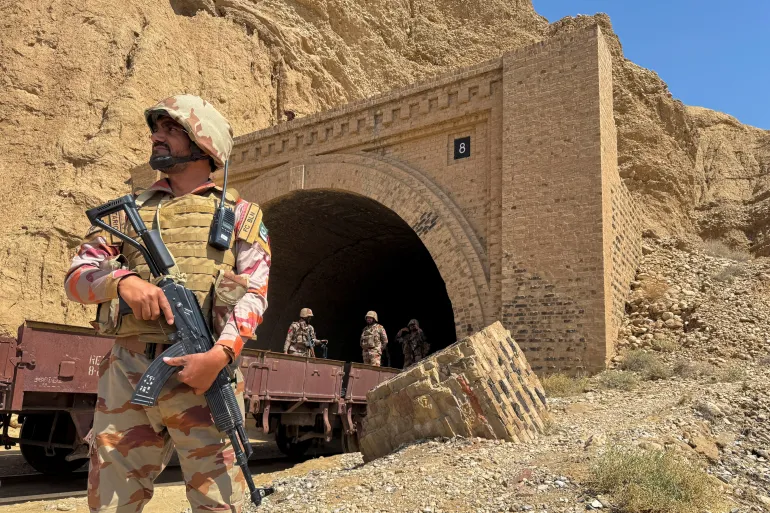
Stretching across Pakistan’s southwestern border, the mineral-rich province of Balochistan is the country’s largest and poorest region, and the site of its longest-running sub-national conflict.
Balochistan’s relationship with the Pakistani state has been uneasy almost since Pakistan came into being in August 1947, following the partition of the subcontinent after the end of colonial rule. The province has witnessed violence since it formally became part of Pakistan a year later in 1948. While the conflict has ebbed and flowed over the decades, it has resurged sharply in recent years, in what analysts describe as an almost unprecedented phase.
The latest escalation unfolded on January 31, when coordinated attacks were carried out in nearly a dozen cities across the province by secessionist groups seeking independence.
Led by the Baloch Liberation Army (BLA), the attackers killed more than 30 civilians and at least 18 law enforcement personnel. Following those attacks, during government operations lasting several hours, security forces said they killed more than 150 fighters.
A day later, Sarfraz Bugti, the chief minister of the province, said in a television interview that the solution to Balochistan’s woes lay with the military rather than political dialogue.
But analysts say that the roots of the conflict – and some of the factors that keep it alive – lie in the final years of British rule in South Asia and the uncertain political geography preceding Pakistan’s independence. On the eve of partition, Balochistan was not a single political unit. Parts of the region were directly administered by the British as “Chief Commissioner’s Balochistan”, while the rest consisted of princely states including Kalat, Makran, Las Bela and Kharan, tied to the British Crown through treaties rather than colonial governance.
In 1947, the Khanate of Kalat was technically independent, a status initially recognised by Pakistan’s founder and first governor general, Muhammad Ali Jinnah.
That position shifted as the strategic value of Balochistan’s coastline – a gateway to the Strait of Hormuz – became clear. Mir Ahmed Yar Khan, the khan of Kalat, agreed to accede to Pakistan on March 27, 1948.
His brother, Abdul Karim, rejected the deal and led a small band of fighters into Afghanistan, marking the first Baloch rebellion. It ended within months with his surrender.
The episode was seen among Baloch nationalists as a “forced accession” and laid the foundation for future resistance.
A pattern soon emerged. Political exclusion gave rise to armed resistance, followed by a military response, and then an uneasy and temporary calm – before the cycle would repeat itself.
Source: Here
