
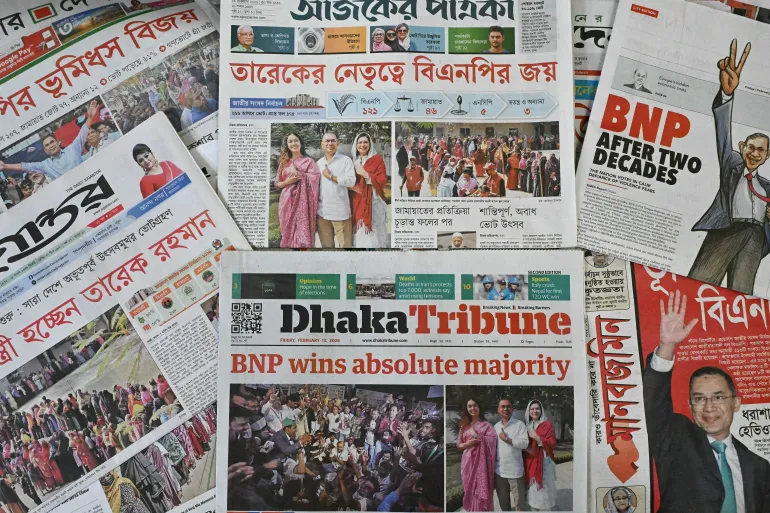
In the end, the 13th parliamentary election in Bangladesh was not a revolution. It was a reckoning.
When the ballots were counted, the Bangladesh Nationalist Party (BNP) had secured a decisive victory, returning to power after years in the political wilderness under Sheikh Hasina’s 15-year rule. Most headlines framed it as a dramatic comeback, and rightfully so. But beneath the surface, this was less a tidal wave of voter choice than a carefully navigated current. This was a contest shaped by frustration and the arithmetic of first-past-the-post (FPTP).
To understand why BNP prevailed, one must first dispense with the lazy narrative that this was a Jamaat moment squandered. When the results became clear, Bangladesh Jamaat-e-Islami (JI) secured 68 seats, while the Jamaat-led bloc secured 77 seats in parliament. That is no small feat for a party whose previous best parliamentary showing was just 18 seats in 1991. Many analysts had suggested Jamaat’s support had grown in the run-up to the poll, and the data vindicated that claim. But in an FPTP system, a swelling vote share does not automatically translate into 151 seats out of 300 elected constituencies.
This election was not driven by any momentous revolution, even though it came on the back of a mass uprising that toppled Hasina’s autocracy in August 2024. But there was no deep ideological rupture, and no permanent reordering of voter loyalties, at least not on a scale that would rupture the very fabric of the country’s electoral mindset. And of course, it was not a national wave election, in which a single mood sweeps towards a particular party across class, gender and region. What unfolded was a hybrid: Largely a normal election with significant deviations, but a predictable outcome.
Party loyalists mostly stayed home. Swing voters mattered. And in pockets of the country, frustration with BNP’s local leadership triggered temporary defections – many of them to Jamaat or NCP.
The anger was real. After August 5, BNP’s grassroots machinery performed abysmally. Petty leaders across districts were accused of corruption and extortion. In rural market towns and urban peripheries, resentment simmered.
Voters were not merely disappointed; they were, to use the language heard in tea stalls and union parishad courtyards, “really, really pissed off”. That fury explains Jamaat’s surge. A portion of BNP loyalists and a significant share of swing voters drifted towards the promise of an “honest alternative”.
Source: Here
