
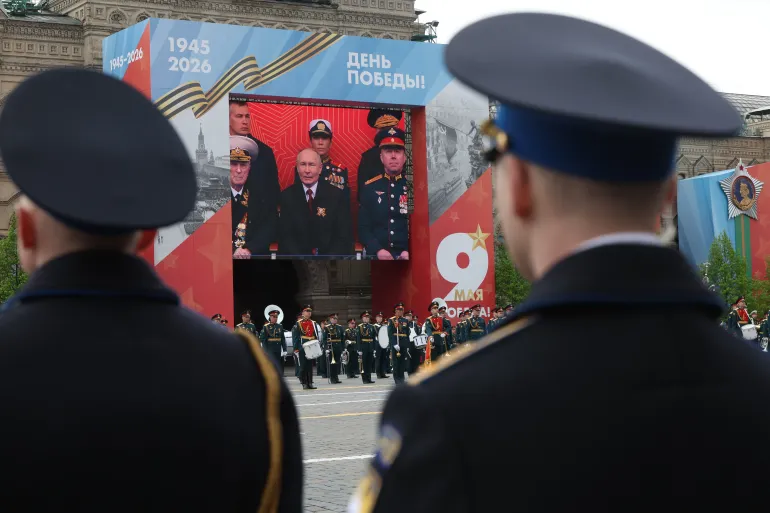
The annual ritual that is the Victory Day Parade in Moscow serves a dual purpose. It reminds Russia’s citizenry and the Kremlin’s audience across the former Soviet Union of the glorious past. The muscle flexing on May 9 each year benchmarks Russia’s geopolitical fortunes.
Last year on the 80th anniversary of the Soviet triumph over Nazi Germany, Russian President Vladimir Putin was flanked by foreign dignitaries from far and wide: Chinese President Xi Jinping, Brazilian President Luiz Inacio Lula da Silva, Slovak Prime Minister Robert Fico, Serbia’s Aleksandar Vucic, Nicolas Maduro of Venezuela, Abdel Fattah el-Sisi of Egypt and Mahmoud Abbas, the head of the Palestinian Authority. This year, the lineup was much less impressive. Leaders from Belarus, Kazakhstan, Laos, Malaysia and Uzbekistan attended – with Republika Srpska, Abkhazia and South Ossetia for some added flavour – but no heavy hitters like India or China.
The talk of Russia as a linchpin of a new multipolar world order rings a tad hollow today, not least because no heavy equipment was marched through during the parade out of fear of Ukrainian drone strikes. On top of it, United States President Donald Trump claimed credit for a three-day ceasefire between Moscow and Kyiv.
The relatively dull affair that was this year’s parade speaks volumes about Russia’s current state. On paper, everything is going just fine. Trump has not wholly abandoned the idea of a deal to freeze the war in Ukraine, even at the cost of major concessions by Kyiv. The current US National Security Strategy calls for “strategic stability” with Russia while blasting Europe’s “woke” policies.The inconclusive war against Iran, meanwhile, has exposed the limits of US military might. Oil prices have jumped, filling Russia’s coffers and improving its fiscal balance. On top of it, Trump has removed sanctions on some Russian oil to increase the global supply. Meanwhile, the Europeans are signalling they want to talk to Moscow.
In reality, the mood is gloomy. The Russian war effort in Ukraine continues to be stalled no matter how much money, materiel and human lives the Kremlin throws into the meat grinder that is the so-called special military operation (SVO). Ukrainian drones have hit deep inside the Russian homeland with even Red Square apparently not being immune to aerial attack.
Trump has lost interest in wooing Putin. With Hungarian Prime Minister Viktor Orban gone, the European Union has consolidated ranks. In Russia itself, economic growth has plummeted from 4 percent in 2024 to a projection of just over 1 percent this year.
The prospects for long-term development, productivity growth and technological innovation are lacklustre. There are modest signs of discontent within the Russian elite. Even Putin’s sky-high popularity ratings are slightly down, according to pollsters.
The stifling of the mobile internet in Moscow and other big cities has been met with dismay. Russians could be excused for puzzling over how the SVO, sold as a glorious repeat of the 1941-1945 Great Patriotic War, has gone on longer than the latter with no end in sight. It is no wonder Putin felt compelled to say on Saturday that “the matter” is coming to an end.
While its resources are focused on Ukraine, Russia is on the back foot in what it still calls its “near abroad” too. The past week showed that Europe is gaining momentum there.
On Monday, Armenia hosted the annual summit of the European Political Community (EPC), where European leaders gathered. Ukrainian President Volodymyr Zelenskyy was in attendance too. Once Moscow’s loyal client and member of the Russia-led Collective Security Treaty Organisation and Eurasian Economic Union, Yerevan is now strengthening ties with the West.
Even if the EPC is dismissed as a pan-European talking shop – or maybe a transatlantic one, given that Mark Carney, the Canadian prime minister, came as well – observers cannot ignore the fact that it was followed by the first EU-Armenia summit. The high-profile meeting signalled in no ambiguous terms that Yerevan sees its future in the EU. Strategically, it is looking at joining the trio of Ukraine, Moldova and Georgia.
Source: Here
