
Oli’s ties with the Indian establishment started to deteriorate after the map row followed by the boundary disputes between the two countries in 2019-20. In response to India’s political map that incorporated the disputed Kalapani, Limpiyadhura and Lipulekh in its territories, Oli, when he was the prime minister, issued a new map in 2020.
Oli again became the prime minister in July last year with the backing of Nepali Congress and since then he has been looking to visit India. To secure an official visit to India, Oli used all possible means to pursue the Indian establishment including by sending his foreign minister Arzu Rana Deuba to India to meet Modi in August but his attempts failed.
In September last year, Oli met Modi on the sidelines of the 79th United Nations General Assembly in New York but that meeting also did not pave the way for his India visit. On Saturday, while returning from Bangkok, Oli told reporters that his meeting with Modi in New York was good.
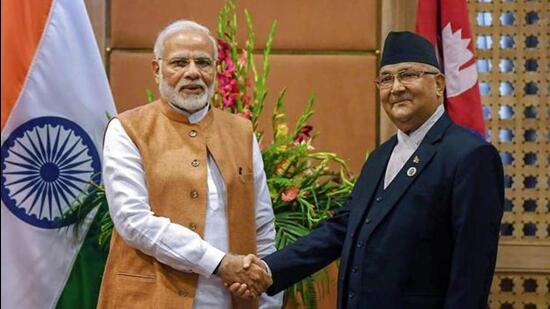
Even after that meeting, Oli kept trying to visit India but could not succeed. Then, Oli and Modi got a chance to meet in Bangkok on the margins of the Bimstec summit.They met one-on-one for over 35 minutes. Statements issued by both sides claimed that the meeting went well and they had frank and candid discussion.
But on Monday, Oli went back to his sour note. He did not mention meeting Modi and restored his ‘nationalism’ card.
“There are several ways to preserve national interest. We need balanced relations but geopolitics cannot be an excuse or tool for compromise,” Oli said. “We have to put our position in a clear way. In the name of geopolitics, we cannot compromise or cover up anything that is detrimental to our national interest. Geopolitics is not a tool to cover up your weakness. We should not give up our justifiable national interests.”
Oli also talked about foreign policy being pursued by his government stating that Nepal is in favour of global peace and peaceful resolution of the disputes, will not take any side, and will not be part of any military alliance.
“We are in favour of peace, we are in favour of humanity, regional and global peace. We do not create any enemy and believe in healthy and balanced relations and fair competition. And we have a kind of national consensus on foreign policy too,” said Oli.
While giving an example of consensus-based foreign policy, Oli said the government of Nepali Congress and CPN-UML is trying to resolve domestic crises as well as political transition. “Whether on domestic issues or foreign policy, we [the UML and Congress] are on the same page. In the United Nations, in Bimstec, in the Belt and Road Initiative, we and Congress are together. We made several agreements in consensus.”
Without unity, no geopolitics, foreign relations or development is possible, said the prime minister. He gave long narrations about how Nepal is a diverse nation but time and again its vulnerability has also been exposed. “During the time of drafting the constitution, we saw our diversity weakening,” he said.
“At one point, during the time of writing the constitution, we thought our geopolitics would give us trouble. But we resolved the crisis. We have faced such crises before and continue to do so, but we have resolved them through unity.”
Source: Here
