
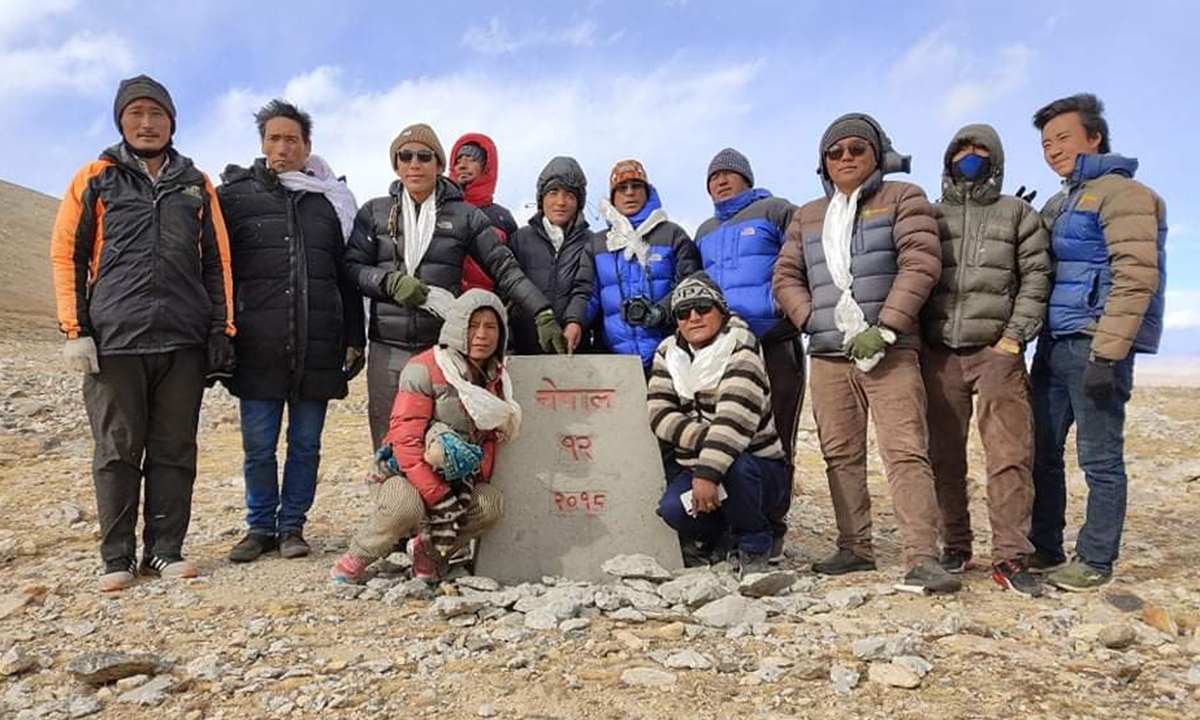
Senior survey representatives from China and Nepal have decided to get together “very soon” in Kathmandu for more boundary negotiations.After an 18-year break, border matters officials from China and Nepal convened in Beijing on June 19 and 20 to discuss concerns related to borders.The foreign ministry spokesperson, Amrit Rai, stated that there was no significant progress made during the conference other than the decision to convene the next one in Kathmandu.
Leading the Nepali delegation at the meeting were Prakash Joshi, director general of the Department of Survey, along with representatives from many line ministries.One participant said the Nepali side proposed an urgent start of the joint boundary inspection that has been stalled since 2006, but the Chinese side did not agree. They did not refuse the idea but wanted more time to prepare, the participant said. The upcoming meeting in Kathmandu could make a decision to this effect. According to officials at the Ministry of Foreign Affairs, the meeting will be fixed through diplomatic channels.
The last meeting of the Joint Expert Group was held in 2006 in Kathmandu. The mechanism mandates a joint inspection of the Nepal-China border, dispute resolution, and finalisation of the fourth protocol to be signed by the two sides. The third Nepal-China boundary protocol was signed in 1988.The two countries are waiting for a joint boundary inspection to investigate issues and disputes on the Nepal-China border and to sign the Border Management System, whose initial agreement was signed during Chinese President Xi Jinping’s visit in 2019.
According to a joint secretary at the Ministry of Foreign Affairs, the Chinese side has sent a copy of the border management agreement, which is now being reviewed by the Ministry of Law, Justice and Parliamentary Affairs. According to a senior official familiar with the matter, although the text of the Boundary Management System is yet to be released, it envisions forming two panels—a joint commission on boundary matters between Nepal and China and a committee of boundary representatives to be led by competent authorities from the two countries. Nepal has yet to ratify the boundary management system.
The good thing is that the cycle has moved, said Rai. The upcoming meeting in Kathmandu will discuss issues of mutual concern.The joint-secretary said the meeting also discussed some outstanding issues, such as the timing and form of inspection and whether it should start again or resume where it left off in 2006.“After the Kathmandu meeting, we might agree on commencing the joint inspection of the Nepal-China border,” another participant said, adding that the possible schedule of such an inspection could be discussed at the meeting.
Earlier, Nepal and China were all set to sign the fourth boundary protocol, which would address issues like the height of Mt Everest and the exact location of pillar number 57 in Dolakha district, among others. But the government called off the meeting at the last moment, and stalling the boundary protocol signing plan.Nepal and China concluded their first boundary talks in 1961 and signed the Boundary Protocol in 1963.
The 1963 Joint Boundary Protocol provides for three different mechanisms to deal with boundary issues: the Joint Inspection Team, the Joint Expert Group, and the Joint Inspection Committee. The mechanisms were enshrined in the Nepal-China Boundary Protocol signed on January 20, 1963. Later, Nepal and China renewed the Boundary Protocol in 1979 and 1988.
While the Joint Expert Group is led by the chief surveyors of the two countries, the Joint Inspection Committee is headed by the deputy director general or under-secretary at the Department of Survey and one of their Chinese counterparts, as per the practice and provisions. The joint inspection committee is led by a joint-secretary at the Ministry of Foreign Affairs.
One of the major boundary disputes was over the height of Mt Everest, which was resolved in 2020 when the two sides jointly announced the new height as 8,848.86 metres. However, several other issues remain unresolved.The Chinese position was more or less the same, the participants said. They want to tie up the boundary meeting, joint boundary inspection, and signing of the boundary protocol to the signing of the boundary management system, something the Nepali side has been dragging its feet over. The Nepali side wants to settle them one by one starting with the joint inspection. These matters are expected to be discussed in detail in the Kathmandu meeting.
As per the boundary protocol, Nepal and China should conduct a joint boundary inspection every ten years and sign the updated protocol, but that has not happened. In addition to resolving disputes, both sides should update the boundary status every ten years. The Nepali side, during the official visit of Chinese Foreign Minister Wang Yi, who is also the State Councillor of China, in March 2022, had proposed forming a mechanism in order to conduct joint inspection of the border and update the latest status. The Nepal-China border spans 1,439 kilometres.
Source: Here
Image source: Here
