
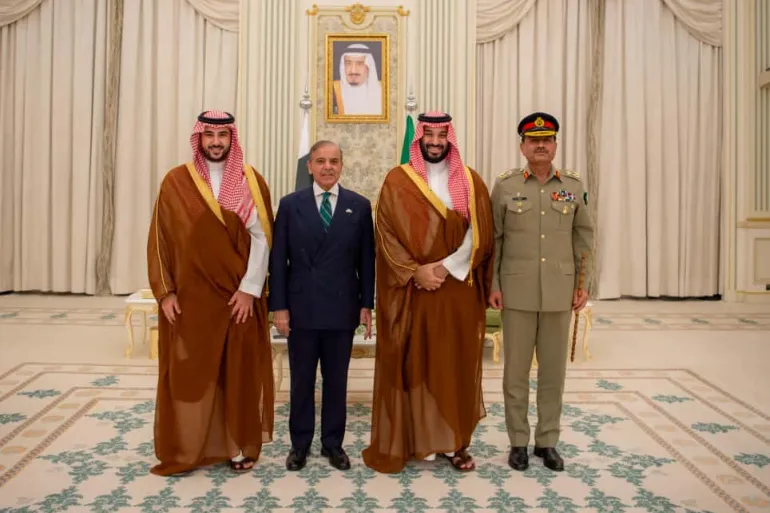
As Pakistan positions itself as a regional security provider, rising militancy and economic constraints continue to test the sustainability of that ambition.
From February 2 to 4, Libya’s eastern commander, renegade military commander Khalifa Haftar, visited Rawalpindi for talks at Pakistan’s army headquarters with the army chief, Asim Munir. The visit might have seemed routine, but it highlights Pakistan’s expanding defence diplomacy in the Middle East and North Africa (MENA). Pakistan reportedly signed a $4bn defence deal with Haftar’s self-styled Libyan National Army (LNA), including 16 JF-17 fighters and 12 Super Mushak trainer aircraft, structured over roughly two and a half years. The acquisition of this 4.5-generation fighter grants the LNA a “game-changing” airpower advantage, potentially upending the military balance with its Tripoli-based rivals unless the latter secures a comparable capability in time.
Pakistan is also reportedly in the final stages of a $1.5bn package to supply the Sudanese Armed Forces (SAF) with 10 Karakoram-8 light attack aircraft, more than 200 drones and air defence systems to bolster its capabilities in the ongoing war against the paramilitary Rapid Support Forces (RSF).
In purely national-interest terms, Pakistan’s growing defence profile in MENA is not a problem automatically. A larger footprint can generate foreign exchange, expand diplomatic access, and increase Pakistan’s visibility in a region where security partnerships are being diversified. It can also strengthen longstanding military-to-military links in the Gulf and beyond. Yet the same burst of activity raises a quieter question: is Pakistan’s foray into MENA largely transactional — focused on exporting weaponry — or part of a coherent strategy to provide security? In other words, Pakistan can export military services and equipment; the harder question is whether it can sustain a “security provider” posture when domestic militancy and border volatility keep pulling capacity inwards.
The Middle East is a useful recent example because it exposes a pattern of contingent, deal-driven activism: Pakistan can offer military cooperation and weapons, and it can gain diplomatic visibility, but the approach is being shaped less by a durable economic base and domestic security stability than by events and short-term openings.
The May 2025 India-Pakistan crisis helps explain why Pakistan’s defence industry suddenly looks more marketable in parts of MENA. Pakistan’s successful counter-air campaign against India, which reportedly included the downing of India’s premier Rafale fighter aircraft, has proved to be a windfall for the country, resulting in a surge in high-value defence partners and customers.
Source: Here
