
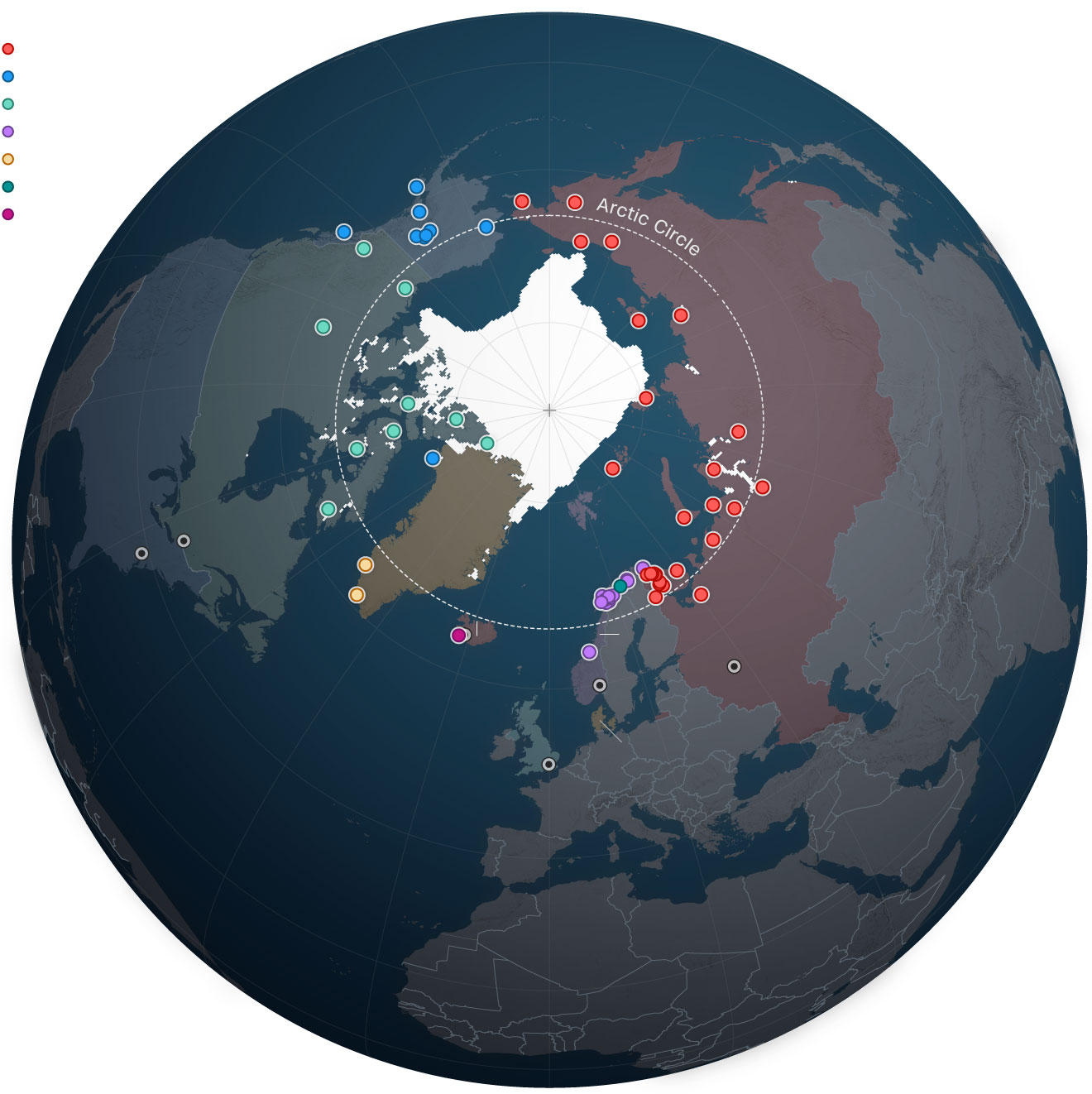
The debate around the Arctic is becoming hotter than ever as US President Donald Trump continues to insist on Greenland becoming part of the United States. But while Trump’s demands that the US take over a territory belonging to one of its closest and most reliable allies have puzzled the world, the race for the Arctic has been on for decades.
And for a long time, Russia has been winning it.
There’s no question that Moscow has had a dominating presence in the Arctic region.
It controls roughly half of the land and half of the maritime exclusive economic zone north of the Arctic Circle. Two thirds of the Arctic region’s residents live in Russia.
And while the Arctic accounts for only a small fraction of the global economy – some 0.4% according to the Arctic Council, the forum that represents Arctic states – Russia controls two thirds of the region’s GDP. Russia has been expanding its military footprint in the Arctic for decades, investing in new and existing facilities in the region.
There are 66 military sites and hundreds more defense installations and outposts within the broader Arctic region, according to the Simons Foundation, a Canadian non-profit that monitors Arctic security and nuclear disarmament. And while not all bases are created equal – experts say that Russia cannot currently match NATO’s military capabilities – the scale of Russia’s military presence, and the pace at which Moscow has expanded it in recent years, is a major concern.
The Royal United Services Institute (RUSI), a UK-based defense think tank, said that Russia has in recent years invested a significant amount of money and effort in modernizing its nuclear-powered submarine fleet, which forms the backbone of its military power in the Arctic. As it continues to fight its war in Ukraine, Russia has also improved its radar, drone and missile capabilities. The picture wasn’t always so perilous. For years after the end of the Cold War, the Arctic was one of the areas where it looked like Russia and Western countries could actually do business together.
The Arctic Council, founded in 1996, attempted to bring Russia closer to the other seven Arctic countries and allow for tighter cooperation on issues such as biodiversity, climate and the protection of indigenous people’s rights. Russia attending two high-level meetings of the Arctic Chiefs of Defense Forum before being kicked out over its illegal annexation of Crimea in 2014.
Most forms of cooperation have since been suspended, with relations between the West and Moscow reaching a new post-Cold War low after Russia launched its full-scale invasion of Ukraine in 2022.
The accession of Finland and Sweden to NATO in 2023 and 2024 has effectively split the Arctic region into two roughly even halves: one controlled by Russia and one by NATO.
Trump has repeatedly said that the US “needs” Greenland for national security reasons, pointing to Russian and Chinese ambitions in the Arctic. He has argued that Denmark, which has sovereignty over the world’s largest island, is not strong enough to defend it against threats posed by the two countries.
Source: Here
