
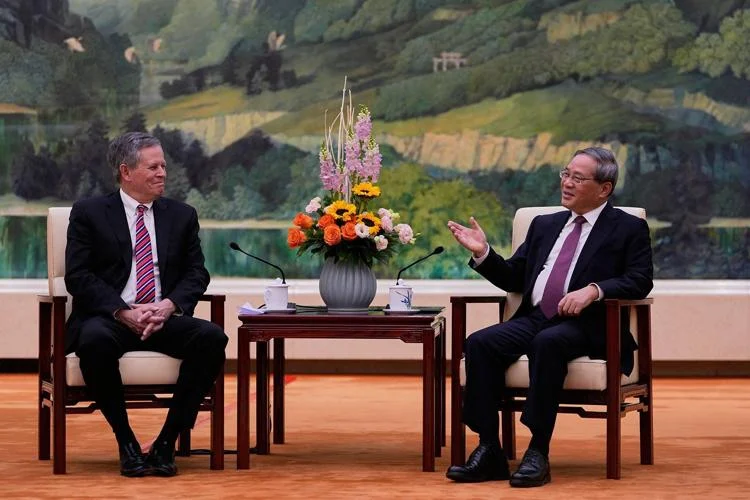
China is prepared for “possible unexpected shocks,” Premier Li Qiang told a gathering of global executives in Beijing, where he urged them to “resist protectionism” and defend globalization.
CEOs including Apple’s Tim Cook, FedEx’s Raj Subramaniam and Pfizer’s Albert Bourla gathered in the Chinese capital over the weekend for a two-day forum that comes as US President Donald Trump has ratcheted up trade pressure on China in a bid to rebalance what he sees as an unfair relationship. Li warned that “decoupling and breaking supply chains would only deepen crises,” while pledging to further expand market access in various sectors for foreign investors.
“If the world returns to the law of the jungle, it will be a step backward in history and a tragedy for humanity,” he said on Sunday during an opening address at the annual gathering. “We have prepared for possible unexpected shocks, which, of course, mainly come from external sources. Where necessary, the Chinese government will introduce new policies to ensure the smooth operation of the Chinese economy.”
The stakes are high for Li’s pitch message, which comes as China seeks to project confidence – and reverse plummeting foreign investment – in its slowing economy at a time when Beijing and the US-China business community are braced for the impact of Trump’s tariffs, which could escalate next month. Executives from major US firms including Qualcomm, Pfizer, FedEx and Boeing also joined that gathering, where Li stressed that the US and China “share extensive common interests and a broad space of cooperation” and called for their “win-win cooperation.”
In a separate meeting between Chinese Commerce Minister Wang Wentao and Apple’s Cook on Monday, Wang reiterated Beijing’s stance that there are “no winners in trade wars,” and “welcomed” the US tech giant to expand its investment and integration in China.
Since taking office in January, Trump has imposed 20% additional tariffs on all Chinese imports to the US, on top of existing levies on hundreds of billions of goods.
China has retaliated with its own duties on US imports, including agricultural and certain energy products, and announced new export controls on raw materials. On Monday, Li signed an order enhancing the country’s anti-sanctions law, state media reported. It said countermeasures could be taken against foreign countries that “contain or suppress” China or adopt discriminatory measures against its citizens or entities.
US tariffs could be elevated in the weeks ahead. The White House is expected to announce reciprocal duties on multiple countries early next week, as part of the administration’s controversial bid to bring manufacturing back to the US and rebalance what they see as unfair trade relationships.
Trump has, however, repeatedly suggested that he hopes to reach a deal with China and Xi. The US president signaled on Friday that America’s top trade official and Chinese counterparts could hold talks this week.The current restructuring of trade relationships requires businesses to be more flexible in their supply chains and to invest in tools like AI to become more adaptable, Rich Lesser, global chair of Boston Consulting Group, said during a forum panel.
“The short-term disruptions demand immediate intention, but the longer-term shifts – in technology, sustainability, geopolitics – are going to reshape trade for decades to come,” he said. For Chinese officials, concern and discussion about such disruptions also provided an opportunity to project China as a responsible power on the global stage and a champion of globalization.
“As a responsible major country, China will firmly stand on the right side of history and the side of fairness and justice. In the wind and waves of the times, we should be righteous and walk the right path,” Premier Li said.
Source: Here
