
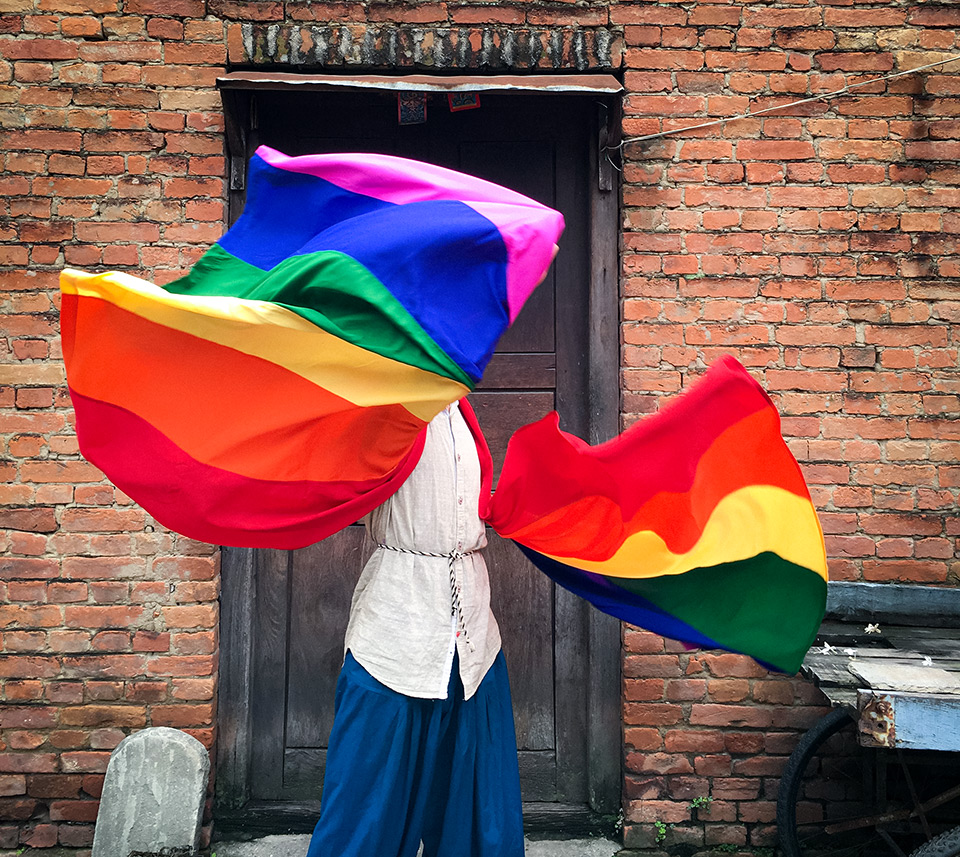
One feels safest at home. However, not for everybody. It’s frequently an unfriendly environment for LGBTIQA+ people. When they come out, the majority face abuse and harassment. Where do you go when violence occurs at home? Who do you turn to when your family rejects you?
One year and a half ago, a transgender girl of fifteen years old committed suicide. Pinky Gurung, the president of Nepal’s oldest LGBT rights organisation, Blue Diamond Society (BDS), said that once the girl revealed her gender identification, she was bullied at home. She had complained about her family’s mistreatment in a letter to BDS, two years prior to her murder.“Most cases of violence aren’t reported as people don’t want to complain against their family members,” says Gurung. Sometimes, these individuals reach out to organizations like BDS or those from the community. But, Gurung adds, family counseling and mediation can do only so much in the absence of strict laws.
Nepal, despite its pro-queer global image, struggles with the acceptance of different gender identities. Despite progressive constitutional provisions, members of the community face all kinds of discrimination. This limits their access to proper healthcare, education, employment opportunities, and legal protection. Dignity becomes a dream.
Discrimination, LGBTIQA+ people agree, starts at home. Families try to ‘cure’ them when they finally muster up the courage to open up. Many are taken to see the doctor and prescribed antidepressants. When that doesn’t ‘set them straight’, beating them into submission is considered another option.
“Discrimination paves the way for domestic and sexual violence,” says Sunita Lama, a transgender rights activist and sex worker. She adds the violence that LGBTIQA+ people experience stems from rigid and hierarchical ideas about sex, gender, and sexuality.
In a study conducted by UN Women, four in five LGBTIQA+ respondents said they had experienced at least one incident of violence. Out of 1,181 respondents, 81 percent reported being victims of violence based on their gender identity or sexual orientation, with 71 percent experiencing emotional violence, 46 percent physical violence, 46 percent sexual violence, and 40 percent economic violence.
The report, titled ‘Evidence to action: Addressing violence against LGBTIQA+ people in Nepal’, further stated that violence was compounded by factors such as socioeconomic status, disability, and caste or ethnicity. The report added that the LGBTIQA+ community, besides battling plenty of stigmas, faces problems related to legal protection, gender recognition, and marriage equality, all of which increase their hardships.
Manisha Dhakal, executive director of BDS, says there isn’t much information, data, or studies on the community. Even in the case of the few studies that have been carried out, there is no follow up. Despite the LGBTIQA+ people regularly facing violence—at home, on the streets, at the workplace—little is being done to tackle it.
Domestic violence largely implies violence against women. The LGBTIQA+ community finds itself sidelined here too. There is no proper mechanism for reporting violence, says Gurung. The police are usually indifferent—refusing to take down their complaints and going as far as to blame the victims.
Lama says the situation is worse for sex workers. There have been times the authorities have refused to believe they could be at the receiving end of violence. The common mindset is that transgenders are aggressive. “The police would rather just lock us up than listen to us,” she says.
There have been a lot of campaigns and programs against violence but most of these have only addressed violence against women, claims the LGBTIQA+ community. The media, rights activists, and the government all have a role to play in this. There is extensive reporting and response to violence against women in comparison to violence against other forms of gender.
“There’s no denying that our society, at large, is still uncomfortable with queerness,” says Lama. Nepal has recently registered its first same-sex marriage, making it the second country in South Asia to do so. However, heterosexual relationships still enjoy a special status in our society.
ApEx asked 20 random people, in Pulchowk and Khumaltar in Lalitpur, if they were comfortable with different forms of non-heterosexual relationships. Most refused to talk about it, a few expressed their disgust with typical Nepali slang—chhya!—and two had to be explained what it meant. Only one, in her 20s, said ‘love is love’.
Organizations lobbying for LGBTIQA+ rights have been conducting awareness programs but the impact is subdued with no outside help. Gender studies is not a part of our school curriculum and gender stereotyping—think blue rooms, cars, and short hair for boys and pink dresses, dolls, and braids for girls—is still the norm.
