
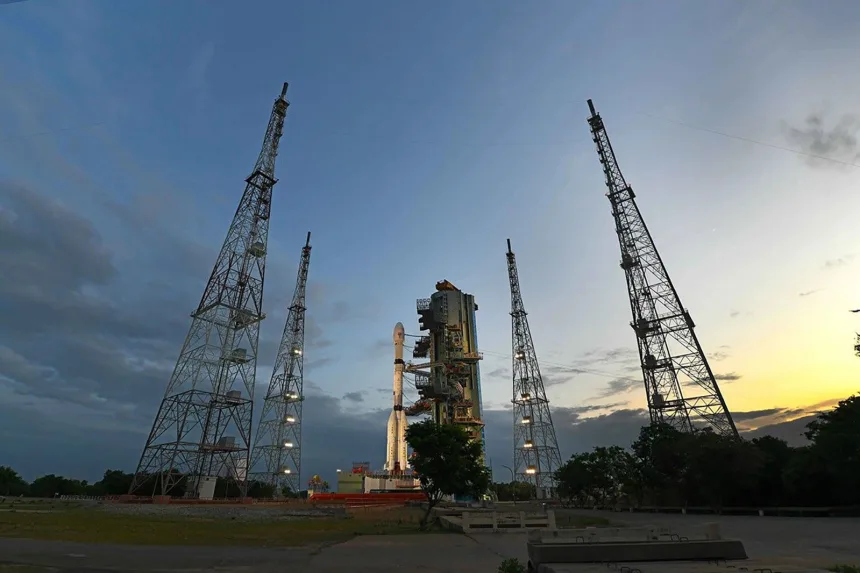
A first-of-its-kind satellite has launched to track nearly imperceptible changes on Earth’s surface, an effort that could aid with responses to natural disasters.
Called the NASA-ISRO Synthetic Aperture Radar mission, or NISAR, the spacecraft is equipped with two kinds of synthetic aperture radar designed by the US space agency and the Indian Space Research Organization in the countries’ first joint satellite project.
The radar, pioneered by NASA to use in space, works like conventional radar in that it uses microwaves to detect distant surfaces and objects. But advanced data processing enables the details to be seen at high resolution. NISAR lifted off from Satish Dhawan Space Centre on India’s southeastern coast at 8:10 a.m. ET (5:40 p.m. IST) Wednesday aboard an ISRO Geosynchronous Satellite Launch Vehicle, or GSLV-F16. The launch was streamed live on NASA+ and the agency’s YouTube channel.
The satellite will orbit Earth 14 times per day in order to complete scans of almost all of the planet’s ice and land surfaces twice every 12 days, detecting changes in Earth’s surface down to fractions of an inch in the process. The mission, first proposed in 2014, will allow scientists to monitor Earth like never before, changing the way we study our home planet and better predicting a natural disaster before it strikes, said Nicky Fox, associate administrator for NASA’s Science Mission Directorate.
“Even though we may not always notice it, much of our Earth’s land surface is in constant motion,” Fox said. “The changes, however, are so subtle that right now they’re virtually undetectable. The need to be better prepared before, during and after the challenges caused by natural disasters around the world could not be greater.” NISAR, which is about the length of a pickup truck, is expected to capture a broad range of information due to its dual radar system — an L-band system with a 10-inch (25-centimeter) wavelength, and an S-band system with a 4-inch (10-centimeter) wavelength. The L-band was provided by NASA’s Jet Propulsion Laboratory (JPL) in Pasadena, California, while the S-band was supplied by ISRO.
“NISAR is an equal 50/50, partnership between NASA and ISRO,” said Wendy Edelstein, NISAR deputy project manager at NASA’s JPL, during a July 21 news conference. “These two radars work together to achieve science that neither could see on their own.”
Source: Here
